Jan 5, 2026
Webinar Recap: “Listen to Your Gut: Is the Microbiome the Next Frontier in Precision Medicine?”
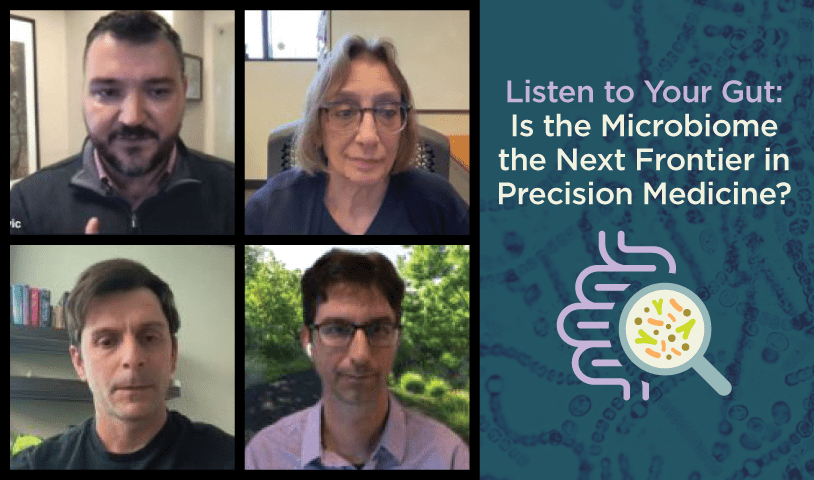
UPMC Enterprises and the Institute for Precision Medicine at UPMC and the University of Pittsburgh (IPM) recently hosted a discussion, “Listen to Your Gut: Is the Microbiome the Next Frontier in Precision Medicine?” The virtual panel explored how microbiome science can advance real-world clinical care.
If you missed the expert panel, watch a replay of the broadcast.
Expert Speakers
The conversation was moderated by Eldin Jašarević, PhD, assistant professor, departments of Obstetrics, Gynecology and Reproductive Sciences & Computational and Systems Biology, University of Pittsburgh School of Medicine; and principal investigator, Magee-Womens Research Institute & Foundation.
Panelists included three leaders shaping modern microbiome science:
- Cathryn R. Nagler, PhD – Bunning Family Professor, Biological Sciences Division, and director of graduate studies for the immunoengineering theme, Pritzker School of Molecular Engineering, The University of Chicago
- Peter Turnbaugh, PhD – professor of Microbiology & Immunology, University of California, San Francisco
- Sam Light, PhD – assistant professor, Department of Microbiology, The University of Chicago
Together, they explored how new discoveries in gut microbiome research are beginning to shape diagnostics, therapeutic development, and digital health.
Why the Microbiome Matters for Precision Medicine
To open the discussion, the panelists reflected on how the gut microbiome is emerging as a powerful yet underused dimension of precision health. They described it as a “missing layer” that helps explain why patients with the same diagnosis, and even the same therapy, can experience dramatically different outcomes. Microbial communities influence everything from drug metabolism to immune tolerance, inflammation, energy balance, and chronic disease risk.
The moderator, Dr. Jašarević, emphasized just how far-reaching these effects are. Drawing from his work on gut–brain development and reproductive aging, he noted that microbiome signals extend well beyond the gastrointestinal tract.
Despite its complexity, the field still depends on careful, reductionist study to uncover the underlying mechanisms.
“We still need these reductionist approaches to understand the signals and the rules,” Dr. Jašarević said, stressing that actionable precision medicine requires understanding why microbial differences matter, not just observing that they do.
From Skepticism to Clinical Relevance
Transitioning the conversation to the early days of microbiome research, Dr. Turnbaugh emphasized clinical relevance was far from certain. Initial studies linking microbes to energy balance and obesity were met with both excitement and skepticism. But as sequencing technologies improved and analytic tools matured, researchers began uncovering connections across immunity, neuroscience, infectious disease, and oncology.
Today, the microbiome is recognized as a critical driver of inter-individual variation in health outcomes. Yet, Turnbaugh cautioned that enthusiasm alone is not enough. The key challenge now is demonstrating that microbiome-driven interventions can truly improve care.
“We need to actually show that we can make a microbiome-based medicine in general,” Dr. Turnbaugh said, underscoring the need for rigorous translation, from mechanistic insight to replicable, clinically validated tools.
Immune Education and Food Tolerance
Dr. Nagler approached the conversation from an immunological perspective, explaining how the microbiome teaches the immune system what to tolerate. Her research identifies specific bacteria and metabolites that contribute to food tolerance, or, when absent, to food allergy and inflammation.
Environmental and dietary changes, she noted, have dramatically reshaped this microbial landscape. Her lab uses model systems to separate cause from effect and pinpoint which microbial functions matter most.
“We have an insight into using the microbiome to improve health,” Dr. Nagler said, highlighting the potential for microbiome-guided interventions in immune-mediated diseases.
Microbial Metabolism and Human Physiology
Dr. Light described the gut as a metabolic engine powered by hundreds of microbial species, each producing unique molecules that influence human physiology. “Each person has hundreds of different species of microbes in their gut,” he said.
These organisms break down dietary compounds into metabolites that function much like drugs, circulating throughout the body. He also emphasized how variations in microbial communities can lead to similar disease states through different mechanisms, a challenge for both diagnosis and intervention. He pointed to hospitalized patients, particularly those heavily treated with antibiotics, as a population that could immediately benefit from microbiome profiling and targeted microbial restoration.
Connecting Human Studies and Mechanistic Models
A consistent theme across the discussion was the importance of integrating large-scale human studies with mechanistic experiments.
“We have to start with some mechanistic insight, apply it to a translational system, and then go back and see whether or not our hypotheses are borne out in the translational setting,” Dr. Nagler said.
Population data reveals patterns, while reductionist models uncover the biological pathways behind them. According to the panel, the most impactful research loops continuously between the two, ensuring that findings are both meaningful and actionable. This iterative approach, the panel agreed, is essential for building trustworthy microbiome-based diagnostics and therapeutics.
What Health Systems Need to Advance Microbiome-Driven Care
Integrating microbiome insights into routine care will require standardized sample collection, sequencing approaches, and analytic pipelines, along with clinical workflows that incorporate microbial data alongside genomics and electronic health records.
AI will be critical for interpreting complex datasets, but Dr. Turnbaugh cautioned, “AI is incredibly powerful, but the models are only as good as the data and the mechanistic understanding behind them.”
The panel emphasized that multicenter collaboration and harmonized standards are essential to ensuring microbiome-guided care is reliable, scalable, and clinically actionable.
Where Microbiome Insights Are Already Making an Impact
The panel highlighted several areas where microbiome science is already influencing patient care and clinical research.
In cancer therapy, Dr. Light noted that the gut microbiome can shape responses to checkpoint inhibitors, “Responsiveness relates to the gut microbiome… and a fecal microbiome transplant can actually switch someone from a non-responder to a responder.”
Beyond immunotherapy, Dr. Turnbaugh explained that microbes can chemically alter chemotherapy drugs, affecting both effectiveness and toxicity. Dr. Nagler pointed to fiber as the clearest evidence-based way to support beneficial microbial activity.
These insights are beginning to guide treatment decisions, support high-risk patients, and shape practical lifestyle recommendations.
Is the Microbiome the Next Frontier in Precision Medicine?
As the conversation circled back to the core question, the panel expressed cautious optimism that the microbiome is positioned to become a major driver of personalized care, so long as excitement is matched with rigorous evidence, sustained discipline, cross-sector collaboration, and scalable clinical tools.
Dr. Jašarević summed up the group’s perspective, “We’re at an exciting moment, but we have to show, not just speculate, how microbiome science can improve patient outcomes.”
Next Steps
- If you missed the expert panel, replay of the broadcast above.
- Catch up with more of our previous webinars.
- Learn more about the Institute for Precision Medicine at UPMC and University of Pittsburgh.